Home | About Us | Subscribe | Advertise | Other Publications | Diary | Offers | Gallery | More Features | Obituaries | Contact |
|
|
|
|||||||||
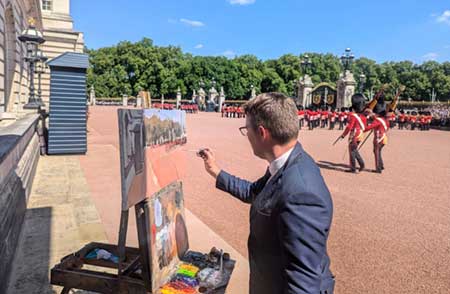
‘As the rehearsal finishes, somebody shouts to just join on the back of the marching ranks. As I fall into line at the rear of some of the finest pomp and ceremony this country can muster, a few things dawn on me; I realise I have never marched before and that I may look a little silly even trying to march whilst out of uniform, carrying my easel and paint gear’.
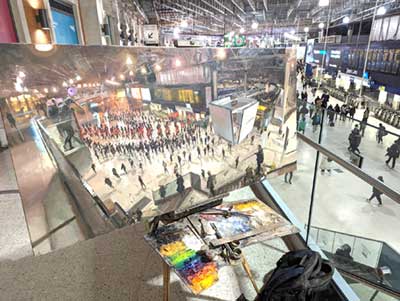
And I’ll bet Rob looked smart as a carrot too. He was always well dressed in jacket and tie, and he had seen plenty of marching up close for this wasn’t his first time in and amongst the Guards. In 2020, in a pandemic stricken Whitehall, Captain Josh Edwards, The Life Guards, had been Captain of the Queen’s Life Guard when a trooper had knocked on his door to tell him that an eccentric man had put up an easel by one of the sentry boxes and was at work painting one of the mounted dutymen. A curious Josh went to see for himself and quickly struck up what would become a firm friendship with Rob, beginning a partnership that would see Rob imbed with the Household Cavalry during the last two years of Queen Elizabeth II’s reign, covering the last Queen’s Birthday Parade and The Queen’s Funeral, among other historic events. Fast forward a couple of years and I found myself admiring Rob’s works from that period when, in 2023, I was posted as a staff officer to Horse Guards where two of his paintings were hung on the walls. I wondered if I could tempt Rob back to London, and after securing permission from The Major General, I emailed Rob out of the blue to introduce myself and see if he’d like to return to the fold. It seemed a natural progression that, having chronicled the Household Cavalry during Queen Elizabeth II’s final two years as our Colonel-in-Chief, he might now turn his attention to focus to the Foot Guards and cover events during our new Colonel-in-Chief’s Coronation year. Rob arrived at Wellington Barracks without fanfare. Before the Coronation rehearsals began in earnest, Rob focused on securing a workable position for the main procession. The timetable allowed little margin for adjustment. Security was layered, permissions were complex, and suitable positions were fiercely contested by reporters, contractors, security, policemen, pigeons and not forgetting republican protestors who wanted a good spot too. Yet persistence and no small measure of good will secured Rob a place beside the statue of King Charles I at the intersection of Whitehall, Trafalgar Square, and the Mall. From there he sketched away and subsequently prepared two large canvases in advance: one anticipating sunlight, the other prepared for rain. The tempo of events building up to the Coronation gathered pace and next on the list was the full-dress rehearsal, to be conducted at night. This saw thousands of troops arriving at Waterloo Station by train before marching across the Thames and through quiet London streets. Rob painted from the mezzanine above the concourse, capturing scarlet ranks emerging onto platforms teeming with late commuters beneath modern ironwork and strip lighting. It was an improbable and compelling sight which Rob described as being like a bright ceremonial flashmob.
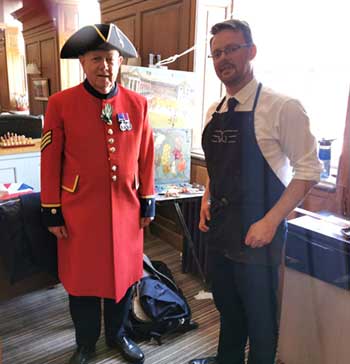
After a couple of weeks away, Rob returned to London to paint a busy summer of events. In June, Rob painted Founder’s Day at the Royal Hospital Chelsea from within one of the communal wards. He found that the vantage provided insight into the lives of the Pensioners’ camaraderie, banter, quiet dignity, while capturing the parade beneath the gilded statue of Charles II.
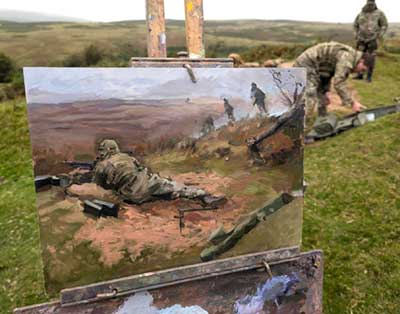
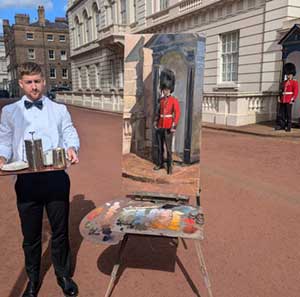
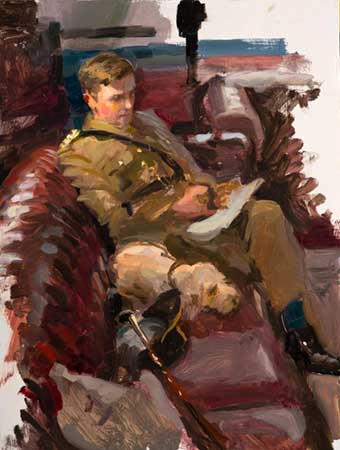
I was keen that Rob recorded the greener side of the Guards and got him into the field. Following a couple of days on exercise with Guardsmen in their camouflage gear, sketching them eating rations, chatting, and smoking, and firing machine guns, Rob’s final installation was back in London, inside the grounds of St James’s Palace. Again, permission had come through from up high, this time for Rob to paint one of the sentries outside Clarence House. Around this time it gave me great pleasure to invite Rob up to the officers’ mess at Jimmy’s when the Micks were on guard so that I could give him lunch and, most excitingly of all, show him the artwork there, including Paul Maze’s rendition of Elizabeth II’s Coronation, painted in the same rainy colours that Rob had used almost exactly 70 years later.
November 2024 saw the climax of Rob’s hard work: the culminating exhibition of his second residency, at Panter & Hall in Pall Mall. Rob is much too modest to say so, but he insisted on donating a sizable sum of the exhibition proceeds to the Household Division Charity. He also gifted to the Household Division one of his most special works of all, a poignant and atmospheric painting of Queen Elizabeth II’s Lying-in-State, which he began in his first residency and, fittingly, completed in his second residency when he was allowed to sneak into Westminster Hall after hours and get the lighting just as it had been in 2022.
It is worth remembering that this all began with a chance encounter on Whitehall during the COVID-19 pandemic with a painter setting up beside a mounted sentry. From that modest starting point came a body of work that now includes the final State occasions of Queen Elizabeth II’s reign, and the Coronation and first ceremonial year of King Charles III, fixed in oil on canvas forever. That is a remarkable outcome for what was, at the time, simply an artist deciding to paint what was in front of him.
|
|||||||||
|
|||||||||


 Captain Billy Richards, Welsh Guards